
Build · Public
Patterns & Signals
The signals beneath the daily noise, read weekly and monthly.
Visit patternsandsignals.com ↗
Challenge
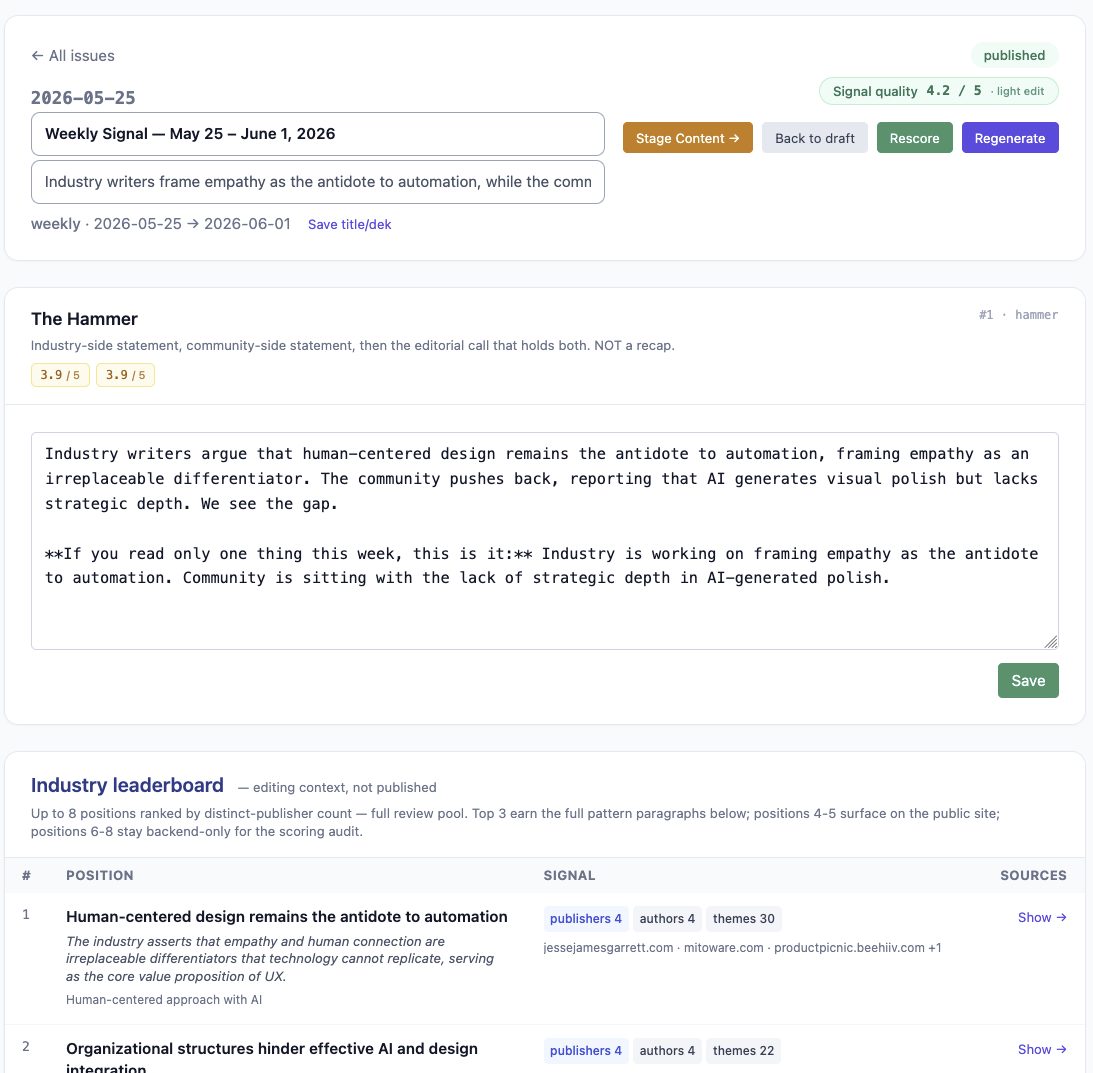
After nearly half a year of scraping the feeds and producing the daily podcast, I had a strong read on what was happening day to day. The daily view is great for that, and it's also loud. So much seems to change quickly and at volume that I started wondering what I was missing underneath it: the slower signals that only show up when you step back to a week, or a month. I wanted a way to see the patterns and trends beneath the daily churn.
Build
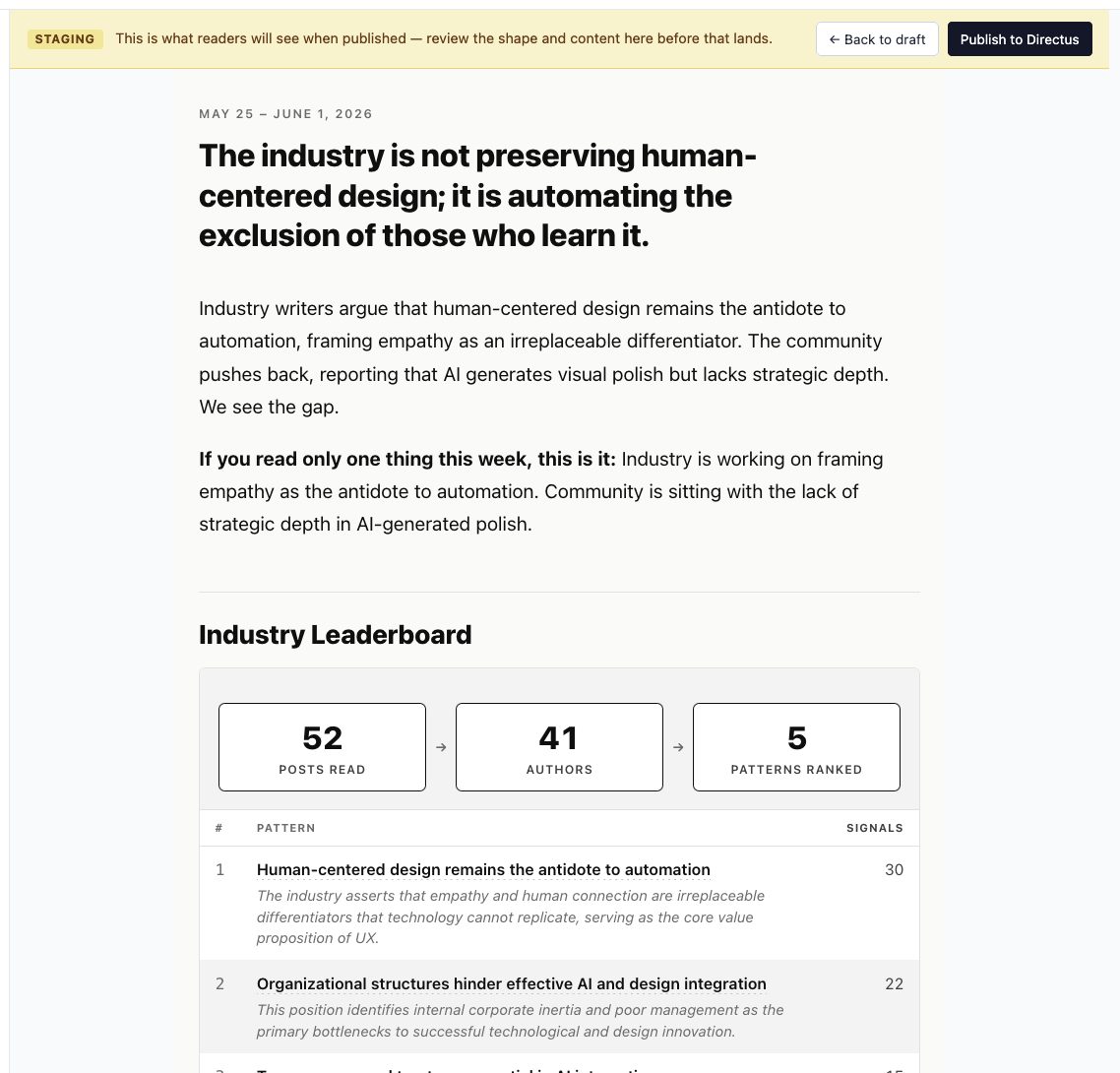
Patterns & Signals reads the same corpus behind the daily podcast across longer windows, a week and a month at a time, looking for the trends a single day can't reveal. It sets the two sides of the field against each other, the industry reporting in the articles and the conversation in the community, to see where they agree, where they diverge, and which dissenting voices are worth noticing inside an emerging pattern. On the back end there's also a speculative view that takes the observed patterns and projects where things might head in the weeks ahead.
Outcome

The result is a weekly and a monthly perspective on where UX is moving, published at patternsandsignals.com. It's the longer-cadence companion to the daily podcast, built to surface the patterns and shifts that only become visible with some distance from the day-to-day.
The Stack
I build the systems with Claude as my pair, working the hard parts until something holds. From there, Qwen carries the ongoing work (the drafting, the summarizing, and the rendering) on hardware I own. Nothing here calls an external model API or bills by the token, which is much of why one person can sustain this much: the judgment stays mine, the repeatable work is automated, and each new build costs almost nothing to add.
- The same daily scraping pipeline behind the podcast, across feeds and subreddits
- Local LLM (Qwen) for the pattern, trend, and speculative analysis
- Mac Mini M4 for development, a dual-GPU Linux server for inference
- Public site at patternsandsignals.com