Build · Public
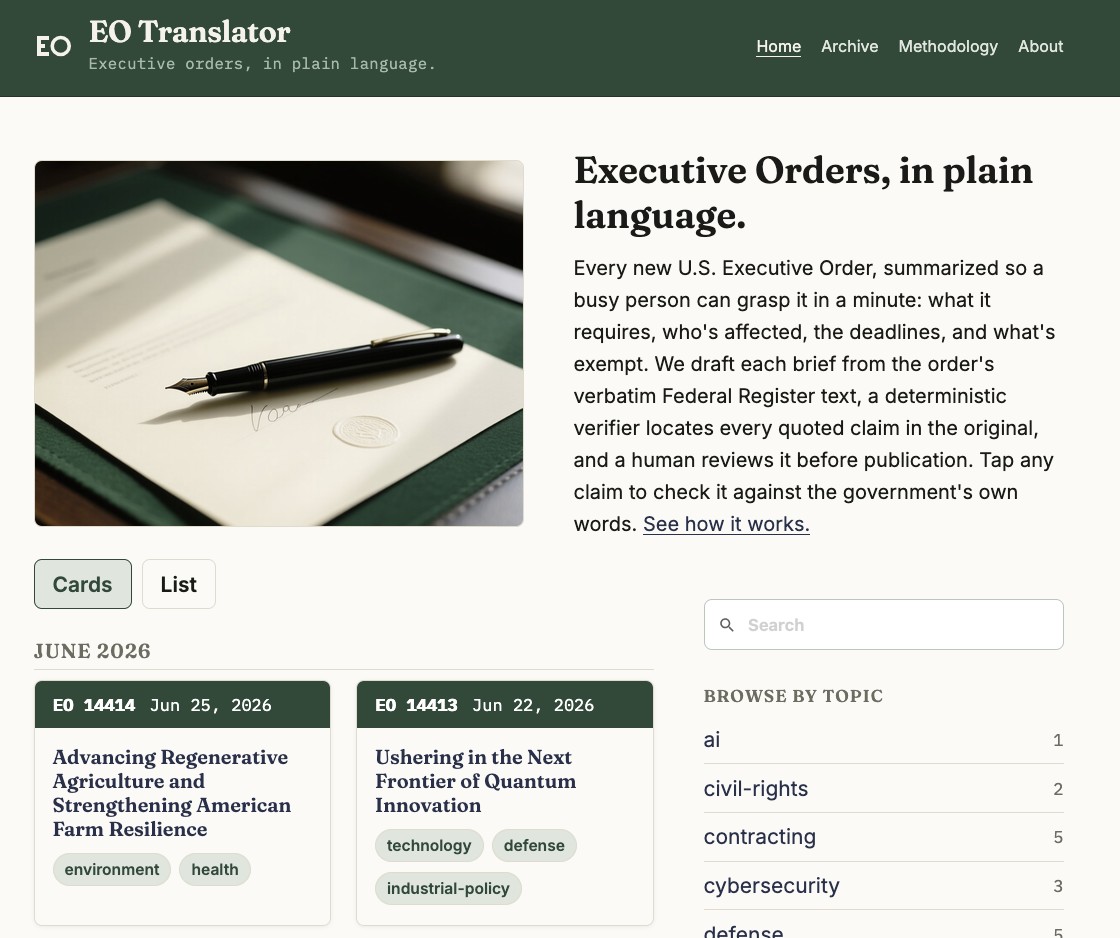
Executive Order Translator
A public tool that ingests every new U.S. Executive Order and rewrites it in plain language, with a clickable receipt on every claim so anyone can check it against the order's own words.
Challenge
Executive orders move real policy: how agencies spend money, who gets hired, and what gets enforced. They arrive as dense Federal Register prose, wrapped in statutory cross-references, in a format almost nobody reads, so most people learn what an order does from a headline or someone's quick take. AI can summarize anything now, instantly and cheaply, which leaves a summary on its own worth almost nothing, because you have no way to know whether it stays faithful to the source. I wanted plain language a person could trust on sight, with the proof one click away.
Build
The plain language is written blind. The model that drafts each summary never sees the raw executive order. It works from a structured distillation of the facts, who has to act, what they have to do, and whether the action is required or merely allowed, with the original legal wording held back. It cannot echo the order's phrasing because it never receives it.
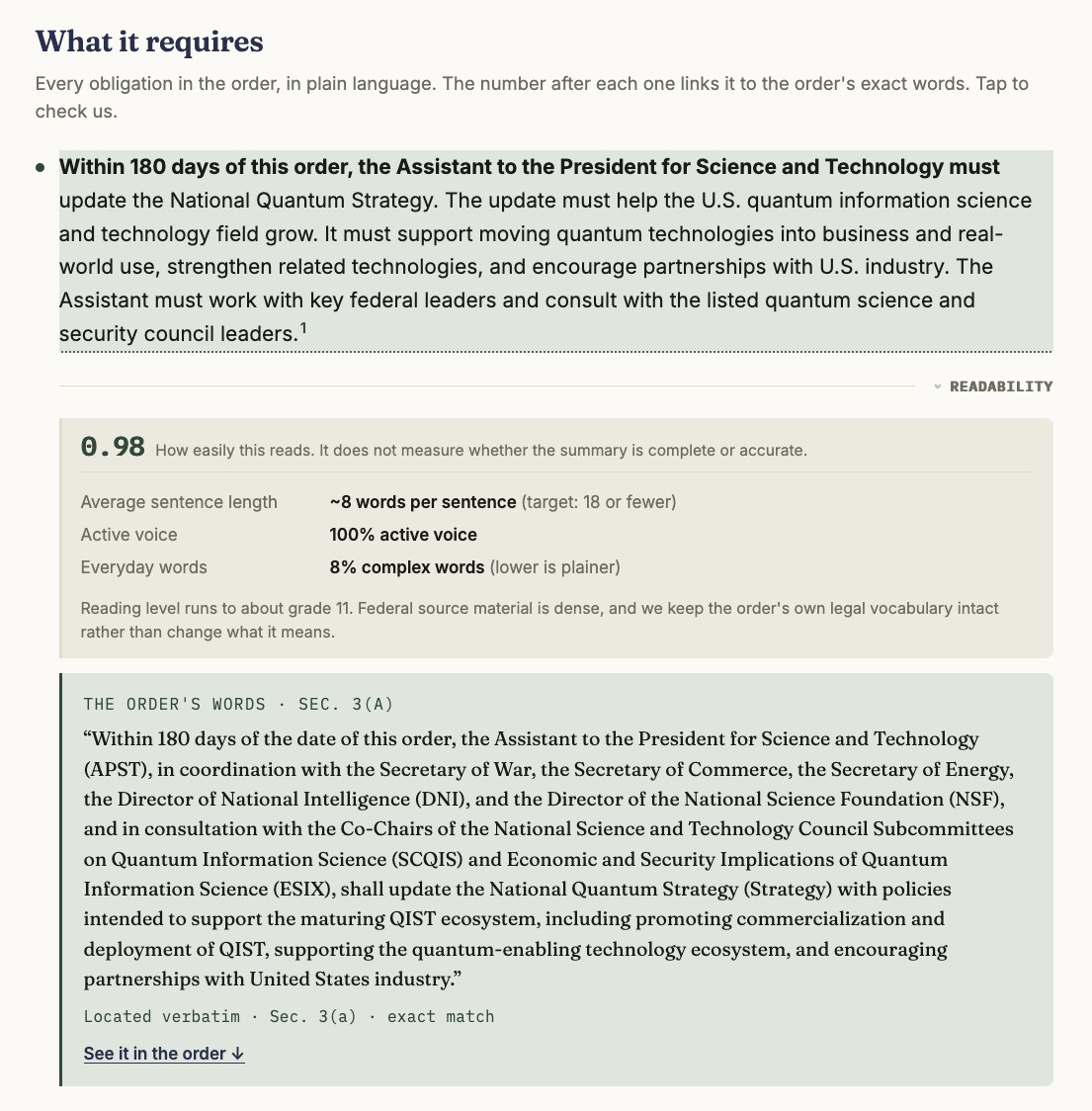
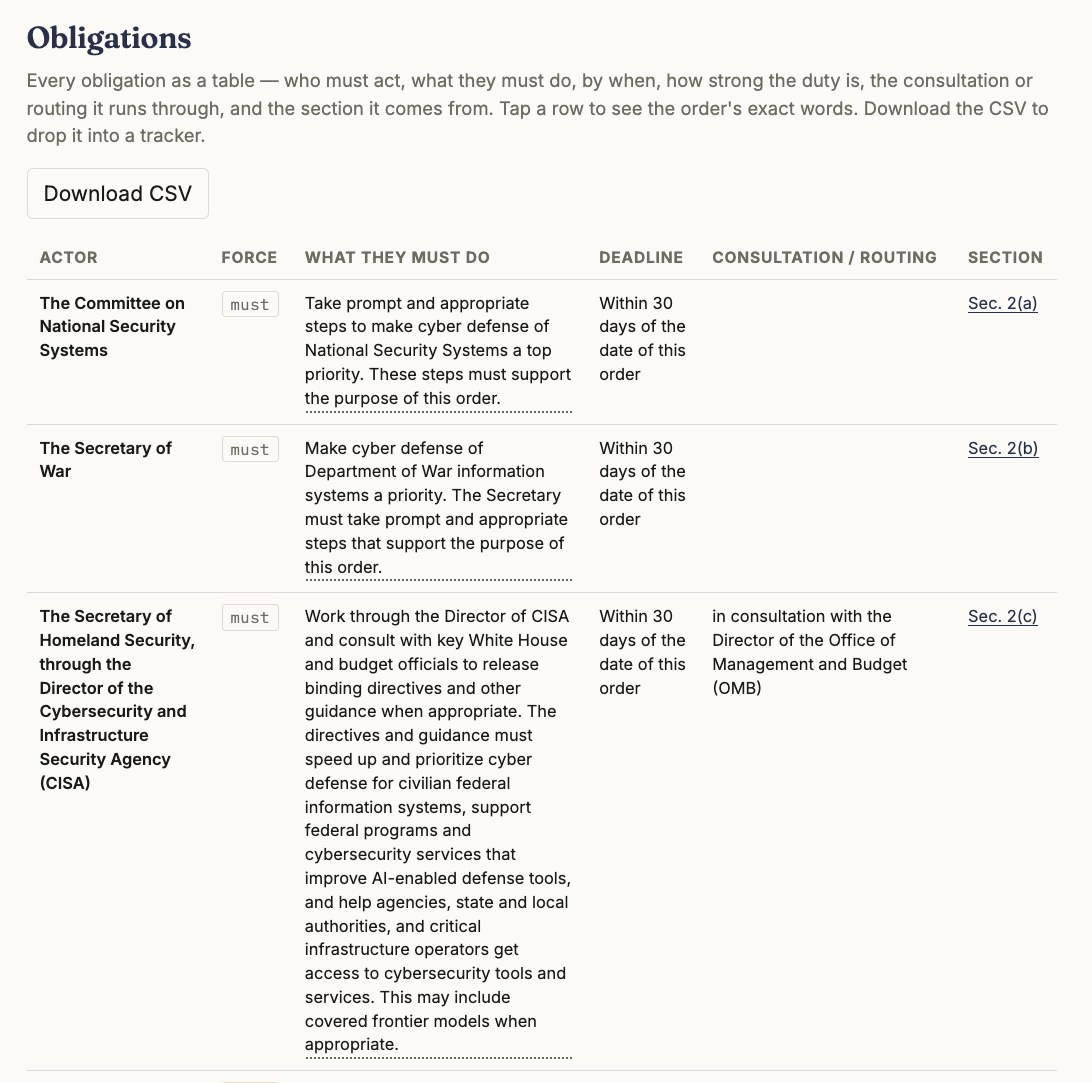
Every numbered obligation traces back, by construction, to a specific quoted span in the order, and a deterministic check confirms each quote exists in the source, character for character. That part is plain string-matching with no model in the loop, which is better math than I can do on my own.
A meaning check then reads the plain language against the order on six points: who has to act, whether the action is required or only allowed, how far the rule reaches, whether the work is finished or still proposed, whether a legal condition quietly dropped, and whether the summary added a characterization the order never made. Anything that reads differently is flagged for the editor, and the editor is me.
Every claim carries a reference number, and that number is the receipt. Tap it and you land on the exact sentence from the order, highlighted in context inside the full official text, right on the page.
Fidelity is only half of it. A summary can be perfectly faithful and still unreadable, so every candidate is also scored against the reader it is written for: a busy adult with no legal training, reading it once, at normal speed, and not going back. Five questions ask whether that person understood it, and the weights come from measurement rather than from me. Each was fitted against a corpus by measuring how well its question separates faithful writing from deliberately bloated writing, so a question that only answers yes on good text counts for more of the score. The fit is provisional, drawn from 61 samples and due to be redone at around 120, so the order of the five is more reliable than the exact numbers.
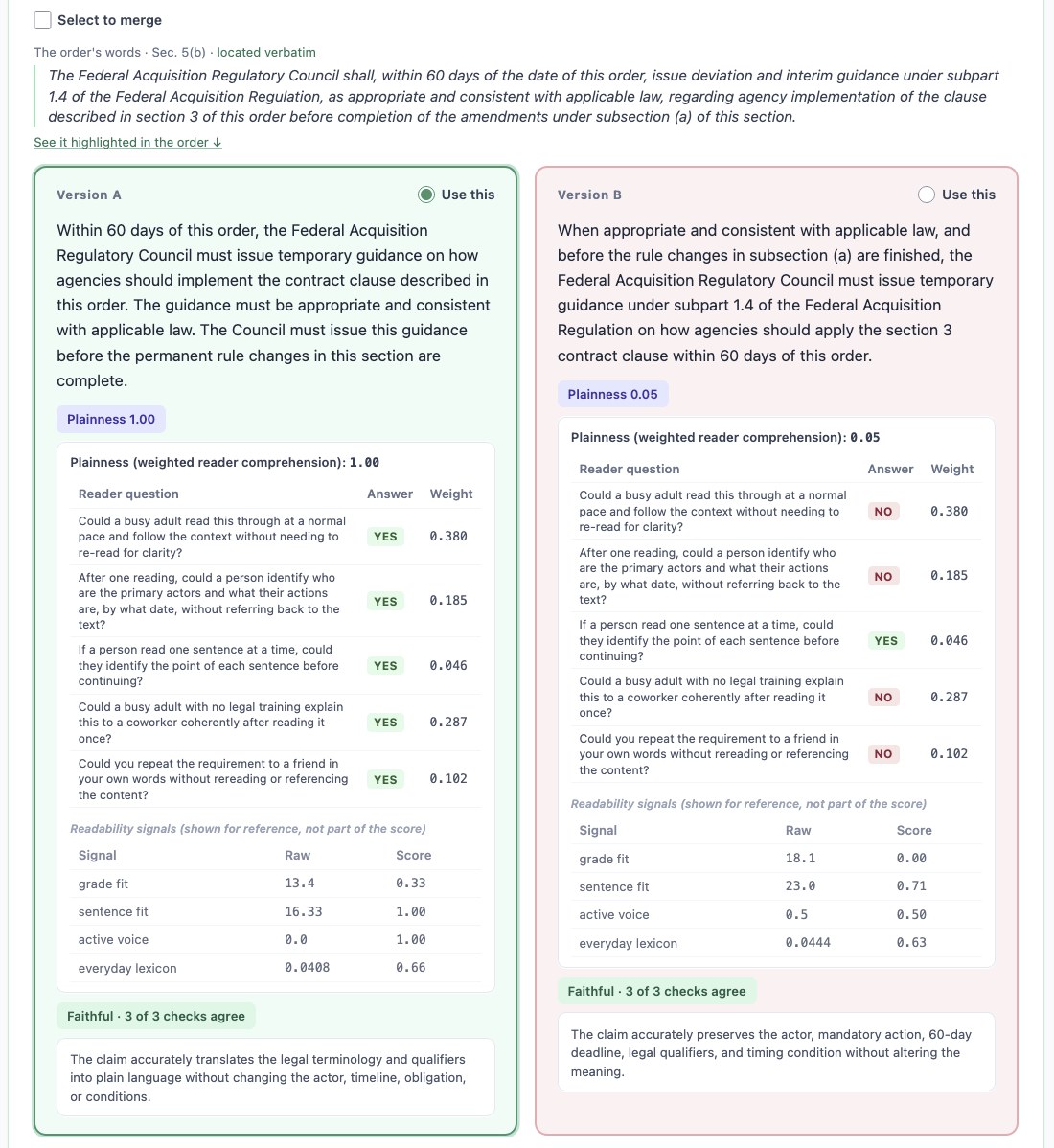
Ranking them turned up something I had not expected. Two thirds of the score is retelling, so whether a person can explain the order to someone else after one read matters more than how well any single sentence is built.

Outcome
Every published order is browsable by topic, searchable, and syndicated by RSS. When the Federal Register amends an order, the affected summary gets pulled automatically until a human reviews it against the new text, so the site stays in sync with the source.
The readers taught me what mattered. The handful who found the site early skipped the flashy quantum-computing order and went straight for federal contracting, land access, and the financial system. The people who go looking for an executive order in plain language are, disproportionately, the people that order obligates, and what they need is exactly the unglamorous work: the qualifiers kept, the consultation chains intact, and the "must" that stayed a "must consider." All that fidelity work turned out to be the end product the whole time.
The fuller story of how it came together lives in Executive Orders. In Plain Language.
The Stack
I make the judgment calls, Claude turns them into plans committed to the repo, Claude Code builds from those plans, and a local Qwen model writes the plain language inside those checks. Nothing publishes without my approval, and nothing gets approved without evidence on the screen.
- Blind drafting: the writing model works from a structured fact distillation, never the raw order text
- A deterministic verifier confirms every quoted span exists in the source, character for character, with no model in the loop
- A six-point meaning check compares the plain language to the order and flags anything that drifts
- My corrections distilled into teaching examples the drafter learns from, so the same governance detail stops slipping
- Automatic pull-and-re-review whenever the Federal Register amends an order
- Local Qwen for generation on hardware I own, Claude and Claude Code for the build