
Build · Internal
Deep Research
Private, local deep research that classifies the question before it searches, and shows every step of its work.
Challenge
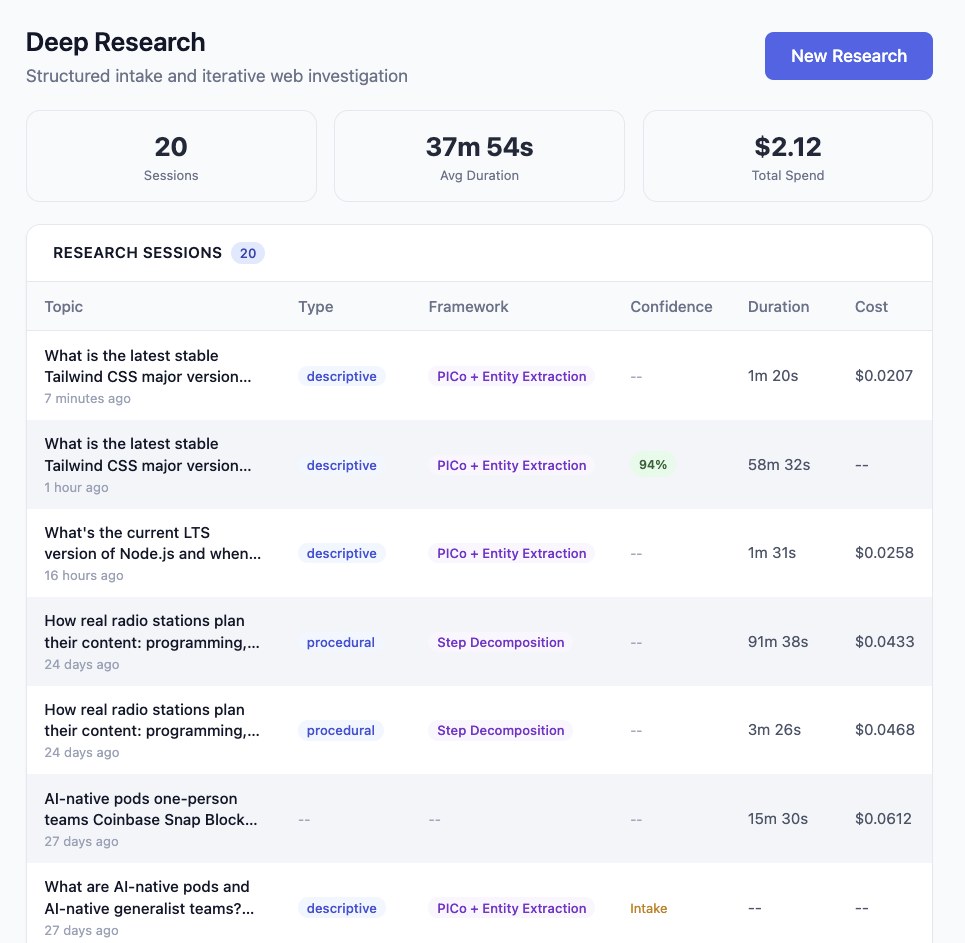
The commercial deep research tools are genuinely good, and they also send your query, your context, and everything they crawl to someone else's infrastructure. For questions about my own systems, my own security posture, or anything I'd simply rather not put out in the open, that's less fine. I wanted real deep research that runs entirely on my own hardware and inference, in the privacy of my own environment. And every commercial tool shares the same weakness: the intake is a text box, with no real sense of what kind of answer the question actually demands.
Build
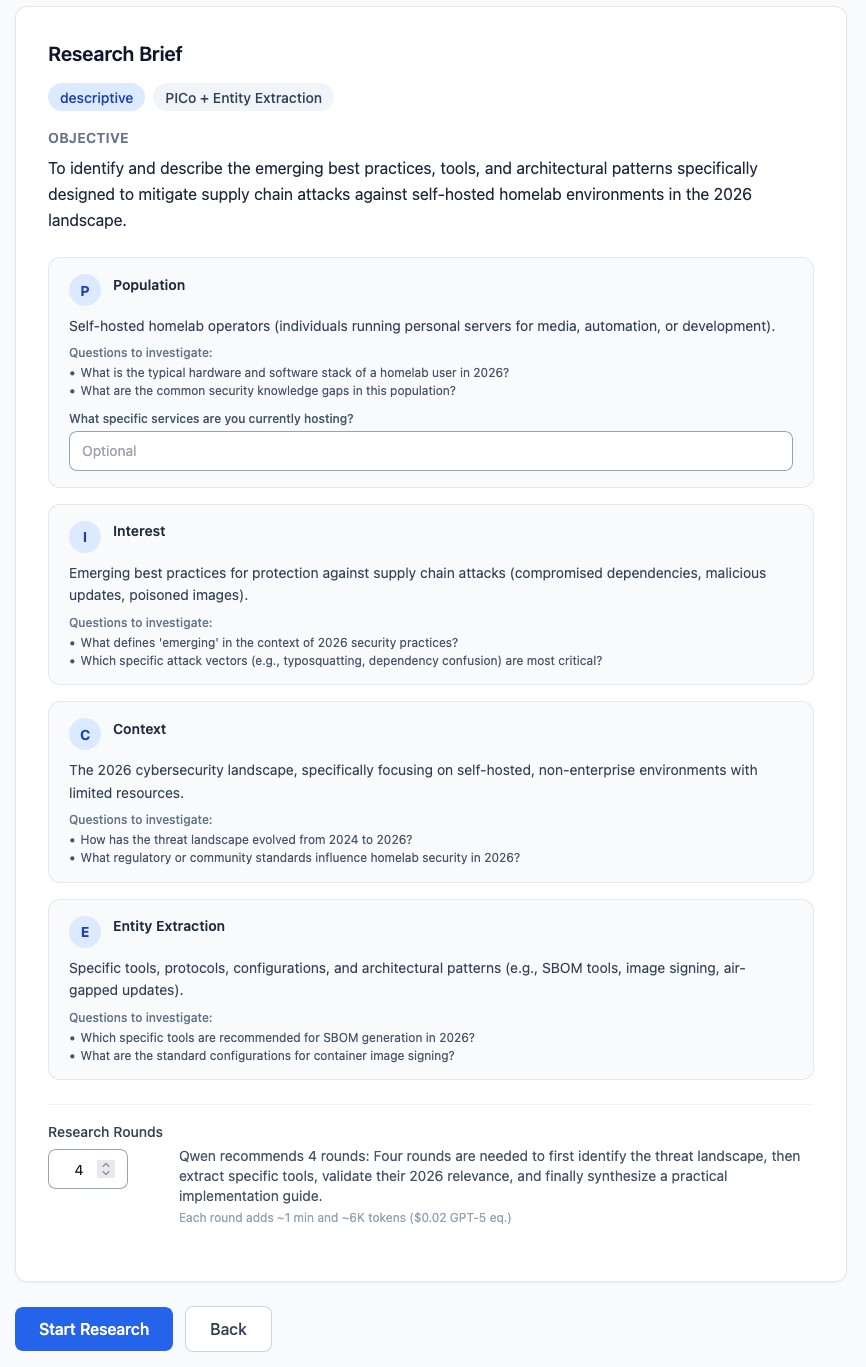
It started by asking Qwen what I was about to ask Qwen to do, using the model's own knowledge of its limits to design the intake before building it. The intake classifies each question by type and maps it to a research framework drawn from research methodology, SPICE for comparative questions, PICO for causal ones, step decomposition for procedural ones, then reads back what it understood, what it inferred, and what it still needs. That moves the quality gate to the input end, where it belongs. From there the pipeline optimizes each sub-question into a real search query, runs it across 100+ engines via SearXNG, scores per-sub-question confidence after every round, and stops when the evidence is sufficient rather than after a fixed number of rounds. Because inference is local, I can run nine to twelve model calls per session without a cost review.
Outcome
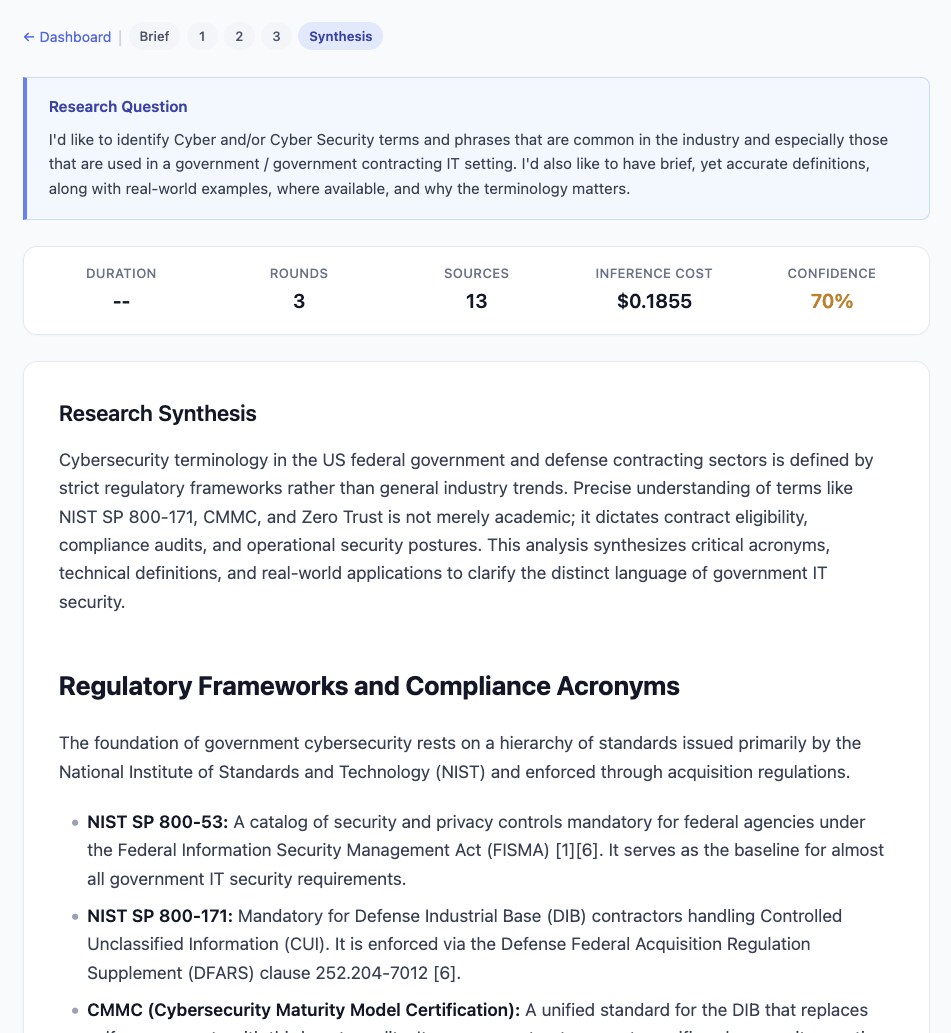
A typical session returns a focused 2,000-word synthesis with 10–15 sources, per-sub-question confidence scores, and a full audit trail from claim to source, with explicit disclosure where the evidence came up short. It flags unsourced claims, notes where sources disagree, and qualifies vendor-reported data as vendor-reported, and it will show every step of the pipeline log for verification. It isn't trying to out-reach the commercial tools; it's the best research a 27-billion-parameter model can produce on a single GPU without sending a byte to anyone else's infrastructure.
The Stack
I build the systems with Claude as my pair, working the hard parts until something holds. From there, Qwen carries the ongoing work (question classification, query optimization, synthesis, and confidence scoring) on hardware I own. Nothing here calls an external model API or bills by the token, which is the whole point: the research stays private, and running it costs only electricity.
- Qwen on local hardware for classification, synthesis, and confidence scoring
- SearXNG metasearch across 100+ engines, kept private
- Per-round, per-sub-question confidence scoring with an evidence-based stop
- Full pipeline transparency: every step logged, no black box
- Mac Mini M4 for development, a dual-GPU Linux server for inference