
Build · Public
5mUX
Five-minute UX lessons, free for anyone learning the field.
Challenge
Getting into UX has only grown harder, and a growing share of the help for newcomers now comes at a price. I already had six or seven books of UX content in a knowledge base, which made the opportunity clear: build my own skills with AI while turning that material into something anyone could learn from, at no cost.
Build
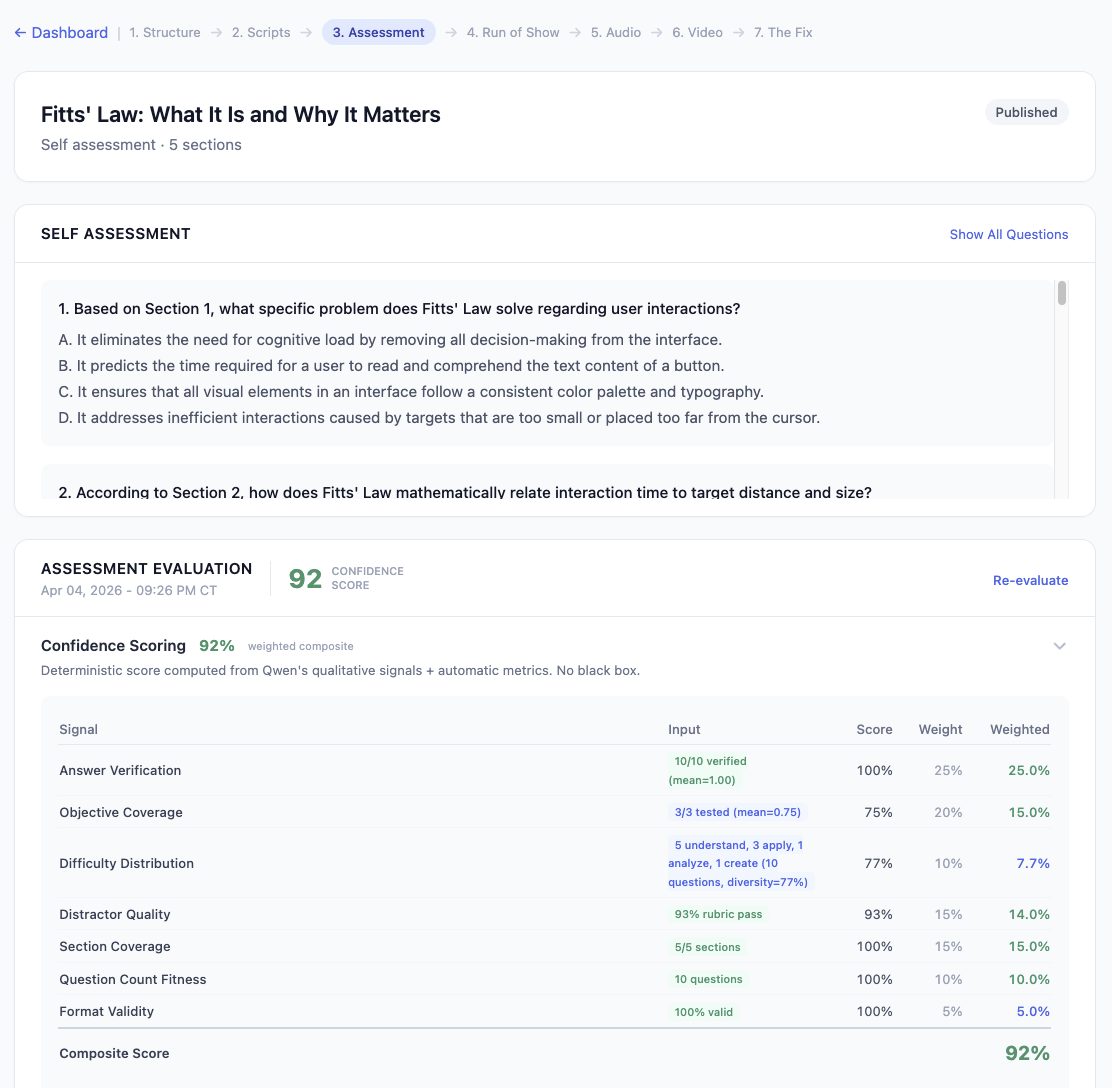
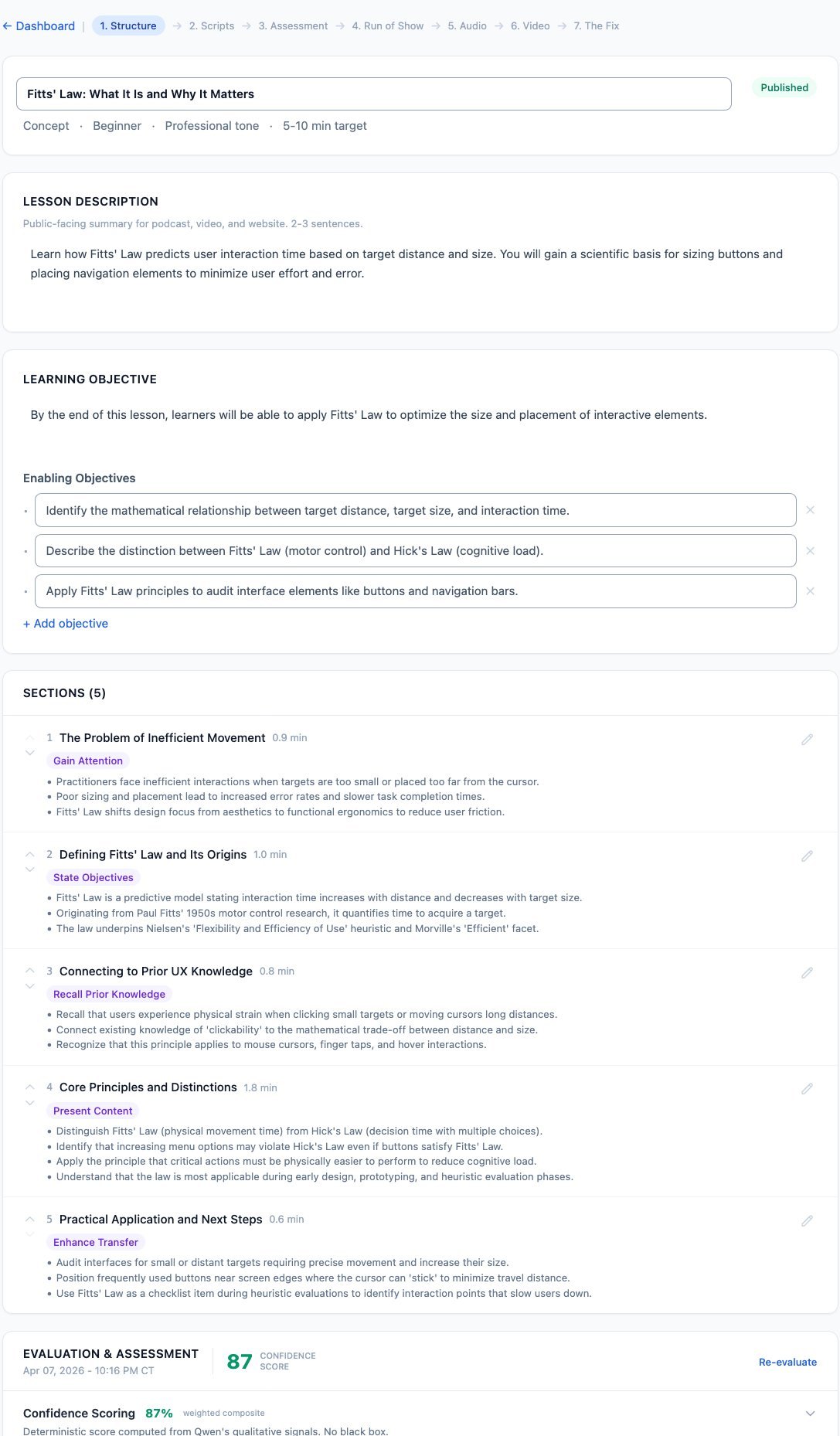
Each lesson follows real instructional design. A prompt to the Books RAG produces the primary and secondary learning objectives, and from those it builds an outline and a script mapped to Bloom's Taxonomy and Gagné's Nine Events of Instruction, so the teaching moves in a defensible sequence. The self-assessment is drawn from those same objectives, so the quiz measures exactly what the lesson set out to teach.
From the finished script, the pipeline produces every format: a text-to-speech podcast, a karaoke-style video rendered in Remotion, and The Fix, a sixty-second piece of microcontent fronted by an AI-generated avatar.
Scoring rubrics evaluate the generated content along the way, holding it to a standard worth a learner's time.
Outcome
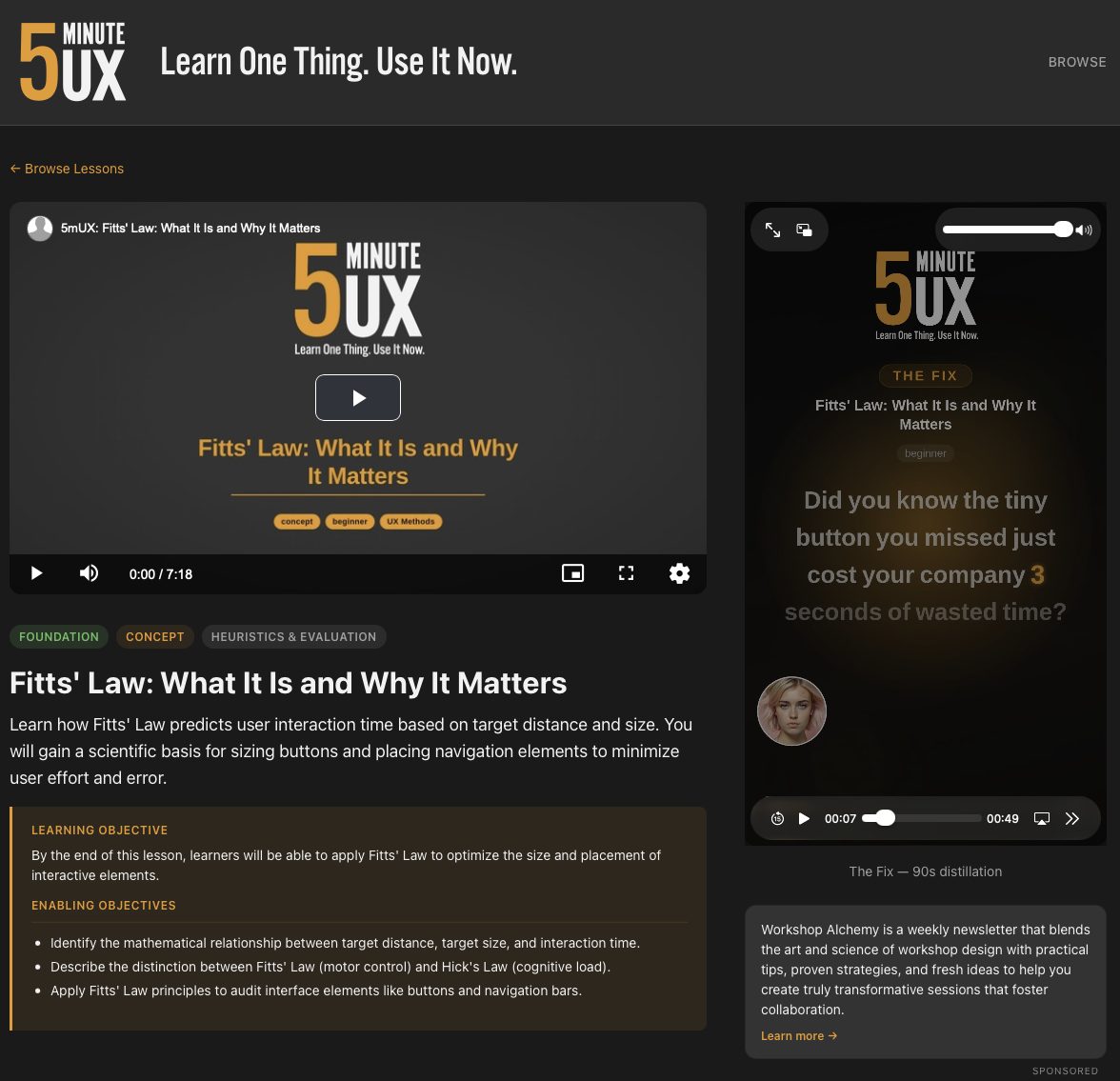
When complete, the library will include more than 1,100 lessons, each on a single focused topic, available free at 5mux.com. Each lesson is offered in three formats, an audio podcast, a karaoke-style video, and the full text, so anyone can learn in whatever way suits them. Every lesson also includes a sixty-second Fix for shorter sessions, a self-assessment quiz to confirm what was learned, and the score used to evaluate its own generated content. Publishing that score is deliberate: the quality is visible and verifiable rather than assumed.
The Stack
I build the systems with Claude as my pair, working the hard parts until something holds. From there, Qwen carries the ongoing work (the drafting, the summarizing, and the rendering) on hardware I own. Nothing here calls an external model API or bills by the token, which is much of why one person can sustain this much: the judgment stays mine, the repeatable work is automated, and each new build costs almost nothing to add.
- Local LLM (Qwen) for objectives, scripts, and scoring
- Local embeddings for the Books RAG
- Local text-to-speech for the audio
- Remotion for the karaoke-style video, plus an AI avatar for The Fix
- Mac Mini M4 for development, a dual-GPU Linux server for inference